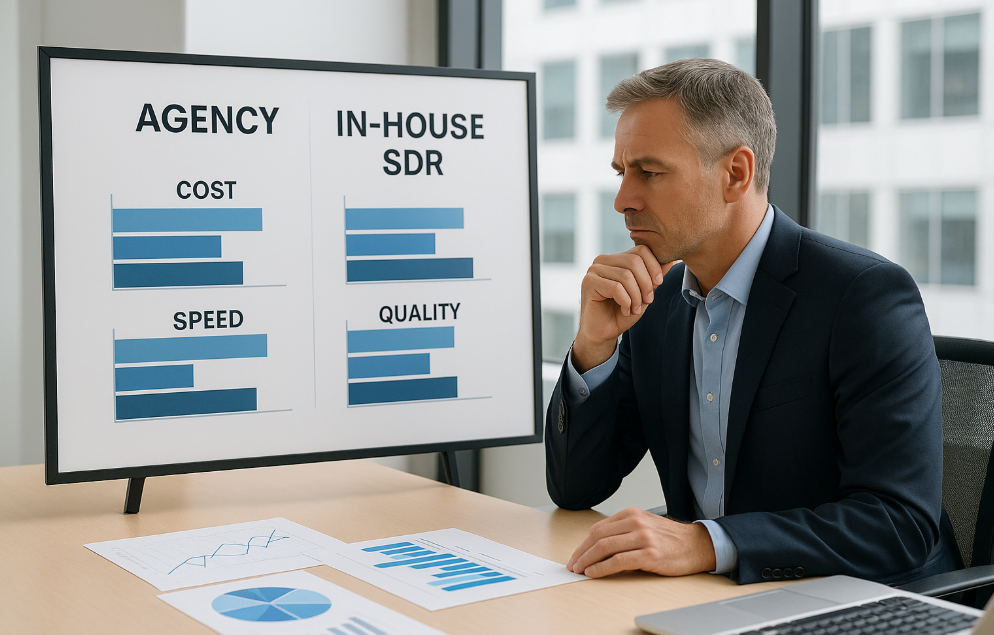
Choosing between a partner B2B Lead Gen Agency vs In-House SDR Team. Which One Actually Protects Your Pipeline and Budget isn’t just an ops preference. It’s a compounding capital allocation choice. The longer you run the wrong motion, the more your CAC bloats and the slower your payback turns. In tight markets, that’s existential.
Your lead engine shapes win-rates, sales velocity, and forecast accuracy. If lead quality is weak, SDRs spin; if volume is inconsistent, reps starve. The outcome is higher CAC, longer cash cycles, and risk to headcount planning.
A low-ACV, high-velocity motion needs consistent volume; a high-ACV, committee sale needs precision and multi-threading. The “right” answer depends on your average contract value, sales cycle, and buyer complexity.
Both can book meetings. B2B lead gen agencies often win on speed to ramp and channel breadth; internal teams often win on deep product nuance and tight internal collaboration.

B2B lead gen agencies typically deliver conversations faster. In-house can be strong later—but only after you’ve built the ecosystem (playbooks, lists, messaging, QA, coaching).

The winning model shows discipline on ICP (industry, size, tech stack, triggers), intent signals, and multi-step qualification. A robust B2B Lead Gen Agency vs In-House SDR Team. Which One Actually Protects Your Pipeline and Budget discussion must ask: Who enforces quality? Who refines personas as data rolls in?
Cold outreach carries legal obligations (consent, opt-outs, data handling). Whether outsourced or in-house, bake compliance into process and contracts.
B2B lead gen agencies let you test segments, geos, and offers without permanent headcount. If your board wants a 90-day Europe pilot, an established partner can staff and execute while you keep internal focus on core markets.
Regardless of model, insist on:
Create a one-page SLA: ICP definition, channels, messaging guardrails, SQL criteria, meeting show rates, pipeline value targets, QA checks, bi-weekly reviews, and a 30- to 60-day exit clause if leading indicators miss. This is how a B2B Lead Gen Agency vs In-House SDR Team. Which One Actually Protects Your Pipeline and Budget decision stays reversible.
Booked meetings ≠ qualified pipeline. Measure opportunity creation rate and pipeline value, not just “meetings set.”
Sequencers, data, and intent tools won’t fix a broken strategy. Start with ICP clarity and a strong message-market fit.
AE feedback is the fastest optimizer. Without it, even the best agency or SDR team drifts off-course.
Why a b2b lead gen agency protects your pipeline and budget: You buy speed, scale, and proven systems with a contractual safety net (SLA + exit clause). You avoid long ramp and turnover risk while tapping cross-client learnings.
Why it protects your pipeline and budget: Over the long run, you may reduce vendor margin and build IP. But you must fund the management layer, coaching, and systems that make SDRs effective.

Start with a B2b lead gen agency-run pilot to open a region or vertical while your internal SDRs cover core accounts. Use a shared ICP, shared dashboards, and a single source of truth in your CRM. Quarterly, rebalance where each side excels: agency for new tests and surges; in-house for strategic accounts and complex collaborations.
Q1. What should I measure first to compare models?
Start with lead-to-opportunity conversion, pipeline value per month, and time-to-first-opportunity. These expose quality, scale, and speed.
Q2. Is pay-per-meeting safer than retainer?
It can align incentives, but watch meeting quality and show rates. Blend with a baseline retainer and SLAs for SQLs, not just meetings.
Q3. How long before I judge results?
Give any model 60–90 days with agreed leading indicators (reply rates, held meetings, SQLs) and weekly tweaks.
Q4. Who should own the data?
You should. Ensure data ownership, export rights, and suppression lists are contractually yours.
Q5. How do I prevent list burn and brand risk?
Require source transparency, throttle outreach, implement compliance controls, and maintain a living suppression policy.
Q6. Can an agency work inside my tools?
Yes—great agencies integrate with your CRM and sequences, or mirror them. Insist on shared dashboards and RevOps governance.
Q7. What if my product is very technical?
Pair an agency pod with internal sales engineers and PMM for enablement; use recorded calls and objection maps. Consider hybrid.
Q8. Which model is better for expansion into a new region?
Typically a B2B lead gen agency—faster ramp, local nuances, and reversible commitment. Transition in-house if the region proves durable.
In the real world, protecting pipeline isn’t about ideology—it’s about speed, quality, and control. A B2B Lead Gen Agency vs In-House SDR Team comparison often comes down to one question: How quickly can you generate qualified opportunities without ballooning CAC or burning your brand? For most CEOs and founders, the agency model wins early and often—because it compresses ramp time, bundles expert talent and tooling, and gives you a contractual safety net with clear SLAs and exit clauses.
When your goals are faster time-to-first-pipeline, tested playbooks, and flexible scale (new geos, verticals, offers), the best agencies act like a ready-made growth pod. They bring cross-client learnings, compliance discipline, and omnichannel execution you’d otherwise spend months building internally. The in-house SDR route can shine later—especially for complex, high-ACV motions with deep product nuance—but only after you invest in management, RevOps, enablement, and coaching. Until then, a top B2B lead gen agency is the safer guardrail for both pipeline quality and budget protection.
Bottom line: If you’re accountable for growth, your first, safest move is a controlled agency pilot. It protects your pipeline by delivering qualified conversations sooner—and it protects your budget by keeping commitment reversible, measurable, and performance-bound. Ready to protect your pipeline and budget? Book a 20-minute pipeline audit to get a tailored plan (ICP, messaging, channels, and a pilot roadmap) and a side-by-side TCO model for your stage.
